

Insights
Ideas, notes, and observations from the work
This space is used to explore questions that come up again and again — about strategy, storytelling, learning, and how organisations change.

The Oldest Technology We Have: Stories
Before screens, before books, before even written language, there were stories...
The Most Effective Learning Experience in History?
What’s the most effective learning experience of all time?Not a course. Not a classroom...
When it comes to learning, selling is telling
Most companies save their creative investment for the marketing department...

"Today, in the boardroom or the classroom, we’re still wired for stories."
The Oldest Technology We Have: Stories
Before screens, before books, before even written language — there were stories.
We told them around the glow of firelight, passing on survival lessons, values, and identity. It wasn’t just entertainment. It was how tribes remembered who they were, how they made sense of the world, and how they stayed together.
Fast-forward thousands of years, and the same force still drives human connection. Stories stick when data slips away. Stories build trust where logic alone falls flat. Stories can move people to act in ways that numbers and facts cannot.
Consider the most widely read text in human history: The Bible.its enduring power lies not in presenting bullet points, but in parables, metaphors, and narratives. Other religions take the same form. Islam has the Hadiths, Buddhism the Jakata Tales, every religion and culture has myths, fables, and sagas that carry knowledge across generations.
We grow up with stories. We all remember the warm comfort of being read to as children — a voice guiding us into sleep, imagination sparked by simple words and pictures. Those bedtime moments imprinted not just the story itself, but the feeling of being safe, close, and cared for.
That’s the real power of storytelling: it works both in the head and the heart.
Today, in the boardroom or the classroom, we’re still wired for stories. Neuroscience shows that narratives light up multiple parts of the brain — emotion, sensory experience, memory — creating stronger recall and deeper engagement. If you want someone to remember, persuade, or believe, you need a story.
This matters in three big arenas we work in at PitchFrame:
- Learning — A well-told story doesn’t just share knowledge; it makes learners care. It transforms dry rules into lived experience, abstract concepts into human journeys. That’s why scenario-based learning, case studies, and role-play are so powerful.
- Brand & Marketing — Attention is the most valuable commodity today, and it’s scarce. Campaigns fail not because they lack information, but because they lack narrative. A brand story isn’t just what you sell, but why it matters, how it helps, and who it changes. That’s the story customers buy into.
- Leadership & Transformation — When you’re leading people through change, you can’t just hand them a plan. They need to see themselves in the journey. The most effective leaders tell the story of where we’ve come from, where we’re going, and why it matters. A compelling narrative unites teams, builds resilience, and helps people carry the uncertainty of transformation with belief and purpose.
From tribal firelight to TikTok, the medium has changed, but the human craving for story hasn’t. The lesson is simple: if you want attention, if you want connection, if you want to last — don’t just tell people the facts. Tell them a story.
That’s where the magic is.
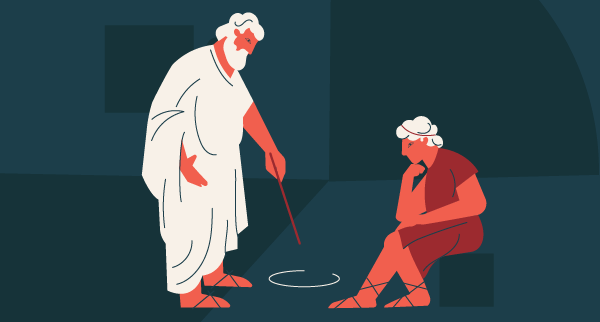
"One of history’s greatest thinkers. One of history’s most ambitious leaders. A teacher and a student, one on one."
The Most Effective Learning Experience in History?
What’s the most effective learning experience of all time?
Not a course. Not a classroom. Not a piece of technology. I'd put my money on it being Aristotle teaching Alexander the Great.
One of history’s greatest thinkers. One of history’s most ambitious leaders. A teacher and a student, one on one. The best possible combination: deep wisdom meeting hungry curiosity. Learning is of course measured on its impact on the student. Alexander went on to build one of the largest empires in history, stretching from Greece to India.
How’s that for return on investment?
That one to one exchange is the gold standard of learning, but the problem is it doesn’t scale.
The rest of education, from ancient schools to modern e-learning, is really about trying to mimic or scale that model effectively. How do we take the brilliance of one great teacher and share it with many? How do we give every learner the same sense of attention, challenge, and transformation even when resources are limited?
That’s the challenge of learning strategy today.
We know no technology can replace the magic of one brilliant mentor shaping one eager student. But technology can amplify and extend it.
- We can capture expert minds through digital media, and turn their insights into training that reaches millions.
- We can use interactivity and simulation to recreate that one-to-one feeling of guided discovery.
- We can design adaptive learning paths that flex to different strengths, just as a great tutor would.
- We can use Learning Management Systems and associated tech to track performance in assessments and identify knowledge gaps.
- We can utilise surveys and chat bots can capture learners desires and aspirations
Connectivity at sea is making it more and more possible to employ these tools, but it still leaves us with a crucial factor we can’t over-look, the motivational effects of having a tutor invested in our success that can hold us accountable.
Pondering the success Aristotle and Alexander is a reminder of what we’re chasing: the power of knowledge transferred directly, interactively, and personally, but also crucially with purpose. Alexander knew he needed to learn how to govern a kingdom and conquer new ones and that made him invested.
Content is good but context is king
So we also need to think very carefully about communication in a learning context. We need to ensure that we are explaining why the learning should matter to our learners. What they can expect to gain from their investment. We need to think about how we are going to win and keep their attention. In my experience this is the piece that is often overlooked, but it is all too often the determining factor in success.
Digital tools in combination with connectivity give us a great opportunity to scale learning and deliver it instantly at the point of need. But we also need to challenge ourselves creatively to bring more of the intimacy, personalisation and purpose to learning experiences to make it effective.
Unlike the weeping Alexander, we still have many worlds to conquer.
"Creativity in learning isn’t about making it prettier. It’s about making it work. It’s what turns information into understanding, and understanding into action."
When it comes to learning, selling is telling
Most companies save their creative investment for the marketing department.
That’s where the big ideas live, the campaigns, the slogans, the beautifully crafted films designed to make customers feel something.
But if creativity’s job is to win attention and move people to act, then learning needs that investment even more.
Because learning without creativity is just instruction and instruction doesn’t change behaviour.
Creativity isn’t decoration. It’s the thing that gives learning emotional charge — and that’s what makes it stick.
Research has shown it. The emotional engagement strengthens recall and turns passive absorption into active participation. In short: creativity makes learning more effective.
Designing the Experience
The first question any creative learning designer should ask isn’t just “What do we want the learner to know?” It’s just as important to ask “How do we want them to feel?”
Learning is an emotional journey as much as an intellectual one. When it’s designed creatively, it invites curiosity. It earns attention rather than simply demanding it.
In industries like maritime — where time is limited, fatigue is real, and operational focus is critical, creativity can mean the difference between something completed and something understood and ultimately remembered.
Small details in design, tone, or pacing can make learning feel like a conversation rather than a chore. That’s creativity at work.
Creativity in Teaching Concepts
The best creative design doesn’t just tell people what to do — it helps them understand why it matters.
A powerful story, a well-chosen metaphor, or an immersive scenario can connect theory to lived experience. Judicious use of video, audio animation and interactivity can bring concepts to life. But it needn’t break the bank. A text-based interactive choose your own adventure story that lets a learner make real decisions in a safety scenario costs little to produce — but it activates reasoning, empathy, and consequence in a way a static presentation never could.
Creativity doesn’t always need a film crew. Sometimes, it just needs imagination.
Creativity in Media and Technology
Technology gives us reach, but creativity gives it life.
We can use short-form video, animation, gamification, or interactivity — not as gimmicks, but as vehicles for clarity and connection. Microlearning can still follow a narrative arc; a single module can still have rhythm and emotional texture.
And where bandwidth or time are scarce, creativity steps up again. Simple, elegant, text-driven or audio-led learning can still inspire — if it’s well written, human, and relevant.
Constraints don’t kill creativity. They sharpen it.
Creativity in Assessment
If learning is about behaviour, then assessment should measure more than memory.
Creative assessment design uses scenarios, dialogue, and branching paths to reveal judgement and understanding — not just recall. Modern AI and adaptive systems can simulate coaching conversations, offering feedback that adjusts in real time.
It’s not about “Did they pass?” It’s about “Did they get it?” and can they take it into their daily life.
Creativity in Motivation and Context
Even the best design won’t matter if learners don’t care. That’s why context is everything.
People need to know why they’re learning something, how it helps them, what it gives them, and why it’s worth their time. When you sell learning the way you’d sell a product, highlighting relevance and reward, you create engagement before the lesson begins..
In the maritime world, creativity is what turns compliance into conviction.
The Creative Imperative
Creativity in learning isn’t about making it prettier. It’s about making it work.
It’s what turns information into understanding, and understanding into action.
We spend fortunes trying to make customers feel something. Maybe it’s time we gave our learners the same respect.